

CBS: CAIR-Chicago files class action lawsuit against StopAntisemitism, Canary Mission for alleged doxing campaign
By Mikayla Price | Updated on: May 18, 2026 / 6:01 PM CDT / CBS Chicago
A class action lawsuit naming six people accuses the online groups Canary Mission and StopAntisemitism of systematic doxing and harassment.
The lawsuit, filed by the Chicago chapter of the Council on American-Islamic Relations (CAIR-Chicago) on March 16, alleges the groups engaged in a "coordinated doxxing campaign designed to chill free speech rights, endanger safety, and inhibit educational, professional, and social opportunities."
The plaintiffs are all from Illinois and are of Arab, South-Asian, Muslim, and Jewish backgrounds. Among them are Dr. Sam Sheikali and Dr. Chandra Hassan, emergency physicians who have volunteered in Gaza and Lebanon, and a Loyola University professor who advises the campus chapter of Students for Justice in Palestine.
According to the lawsuit, the plaintiffs were targeted for "engaging in constitutionally protected political speech opposing Israel's war crimes, mass civilian harm, and U.S. foreign policy regarding complicity in the genocide of Palestinians." The lawsuit details how the plaintiffs' jobs were threatened or they were fired, their speech was suppressed, and their safety was jeopardized.
The lawsuit targets two distinct groups, both of which publish people's personally identifiable information, whom they label "antisemitic" or "anti-Israel."
StopAntisemitism, founded by Liora Rez, posts what it calls "name-and-shame" profiles on social media with a call to action to contact people's employers. Rez claims a "remarkable success rate," writing that StopAntisemitism has "profiled more than 1,000 people" and that "over 400 of them have been fired."
Canary Mission is an anonymous site that uploads and maintains thousands of "profiles," primarily of college students and professors. Its website says it obtains information from publicly available sources and from materials submitted privately through its website.
CAIR-Chicago said these groups largely target Muslim, Arab, and Palestinian students and young professionals. Rez says StopAntisemitism does not dox its targets.
The lawsuit uses Illinois' civil liability law, which went into effect in 2024, allowing people who believe they are victims of doxing to sue for damages and appropriate relief, such as a restraining order.
Illinois is one of the only three states, alongside Alabama and California, that have created their own definition of doxing and established it as a standalone crime. Under that law, doxing is defined as the "intentional publication of another person's personally identifiable information without their consent."
It is illegal in Illinois when "done with the intent to cause harm or harassment and knowledge or reckless disregard that the person will likely suffer serious injury, stalking, economic injury, emotional distress, or a substantial life disruption."
Noah Halpern, a lawyer with CAIR-Chicago, said the evidence is clear.
"One of the things we talk about a lot in the complaint, and how we think about doxing versus free speech, is the intent to harm and harass. [The plaintiffs] very literally have been harassed. It also speaks to how these organizations operate; they target the messenger, not the message," he said. "This is not the space to argue whether or not what Israel is doing is genocidal."
Laura Goldstein, the only Jewish plaintiff, echoed that sentiment.
"I can talk at length about how deeply I feel connected to my Judaism and connected to my heritage, and that does not mean that I condone genocide," they said. "It's not about having conversations. It's about shutting people down through intimidation and threats."
Sheikali faced direct threats to his reputation that nearly cost him his job and board certification. He spoke with CBS News Chicago before the lawsuit was filed.
Sheikali's case
In March 2025, Sheikali's phone flooded with hateful messages. He was confused until his wife found the StopAntisemitism post targeting him.
The post shared his name, photo, social media handle, and the hospital where he works, and ended with a call to action to email the hospital's media relations manager about his views on Gaza and criticism of Israel. StopAntisemitism called him a symptom of the latest epidemic in the medical field of "cancerous antisemitism" and provided the email to his workplace's media contact.
"They took a lot of my social media content out of context and added a lot of their own," Sheikali said.
He said that being doxed brought about a "complex mix of emotions."
"I was angry that they could get away with their tactics to harm people's careers, and I was worried about my family's safety," he said. "People were starting to reach out to my place of work, mass emailing and calling the HR department at the hospital system where I'm currently working."
Halpern said campaigns set up a TinyURL or shortened web address for people to send a copy of a pre-written email to workplaces.
Sheikali said he received a call from a director at his workplace, OSF Healthcare, that he had been investigated and ultimately found in good standing.
In a statement to CBS News Chicago, OSF Healthcare said, "OSF HealthCare followed our internal protocols in reviewing the matter related to Dr. Sheikali. We have no further [comment] on the situation and would direct any additional inquiries to him personally."
Then, in May 2025, Sheikali received a letter from the American Board of Emergency Medicine (ABEM) that warned his certification could be revoked due to his social media posts, calling them "extremely anti-Zionist" and saying his posts "seek to characterize Israel as unacceptably evil."
"I've never seen a letter like that sent to anybody else from any of the different specialty boards. I was double-checking to see if this was even a legitimate letter," he said.
He brought the letter to CAIR-Chicago.
"It is bizarre for an organization like ABEM, the American Board, to have or place limitations on how somebody's going to speak on a foreign policy issue," Halpern said.
"It's now safer to protest against the President of the United States than to protest against the foreign state committing genocide," Sheikali said.
In a series of written exchanges between May and October, Halpern walked ABEM through the details, citing 20 points to "support Dr. Sheikali's political speech, provide further context and clarity as to why his posts are not racist or antisemitic, and to reaffirm Dr. Sheikali's commitment to ABEM's ethical and professional standards." CBS News Chicago independently verified this letter.
The CAIR letter also stated, "We suspect that Dr. Sheikali's posts were first brought to ABEM's attention by a series of hyperbolic emails calling for Dr. Sheikali's certification to be rescinded."
"They went for a certification, probably because they were upset that the hospital did its own investigation and didn't just listen to them," Halpern said.
In a final letter, ABEM stated that it would "not take further proceedings" and that "ABEM is not imposing specific restrictions on Dr. Sheikali's personal speech moving forward."
CBS News Chicago also reached out to ABEM for comment and received the following statement: "ABEM does not comment on individual physicians or disclose communications regarding physicians."
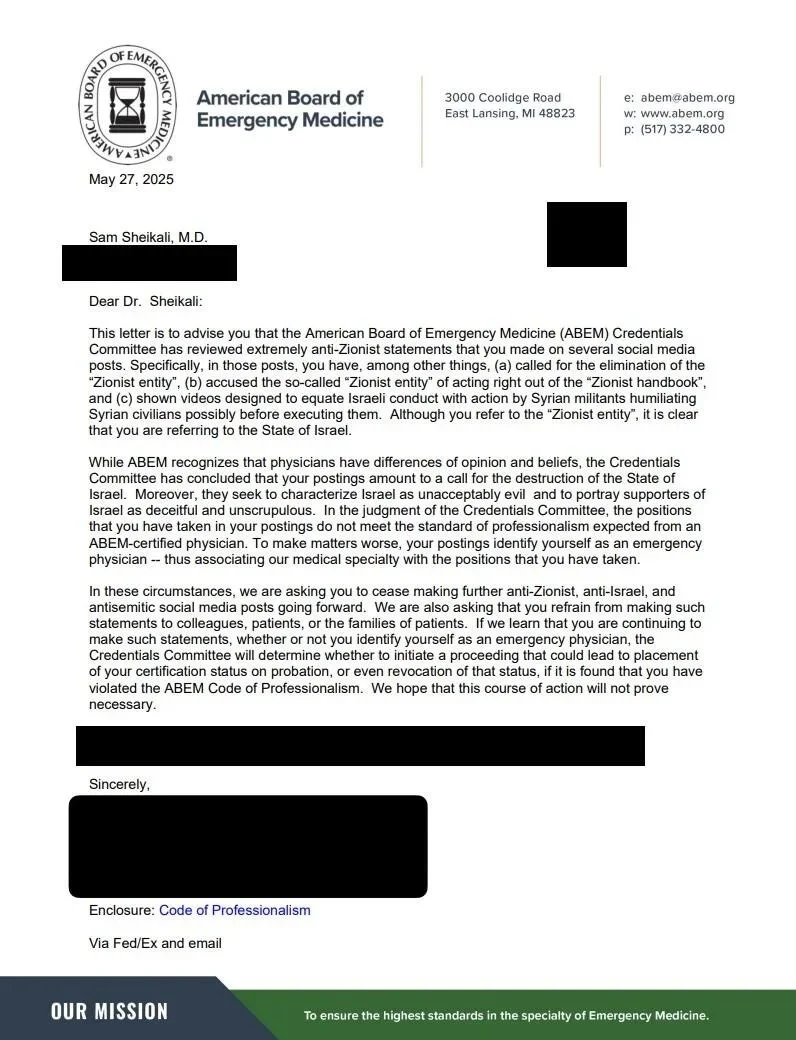
ABEM letter to Sheikali (Sam Sheikali)
Israel's war is personal to Sheikali; his own family members have been killed and displaced in Lebanon.
He was so moved by the bombing campaigns in Palestine that he tried to volunteer in Gaza, but instead was given the opportunity to treat and teach emergency medicine in Lebanon.
"I finally had a chance to do something with my hands instead of my voice in the face of genocide, and if I didn't take that opportunity, it would haunt me for the rest of my life," he said.
In 2024, Sheikali treated mass-casualty patients and taught local doctors how to use portable ultrasound devices on injured civilians.
"I firmly believe that I had a moral obligation to help." His grandmother and over a dozen of his family members were displaced earlier that year from their home in Ansar, in southern Lebanon.
Sheikali briefly reunited with his grandmother for the first time in 13 years.
"Usually, we would be picking fruit from her garden, but this time we rushed while drones flew overhead, missiles struck," he said, calling the short moment with her "bittersweet."
He said his work in Lebanon further strengthened his stance to speak up online, which he said increased after he returned to the United States.
"Having lived the violence against civilians and a witness to war crimes, fueled my need to stand up against injustice," Sheikali said.
Sheikali said he is used to receiving hate for his stance on Israel, Gaza, and Lebanon. He said other emergency physicians have spoken about him in a private Facebook Emergency Medicine group.
"Some of the most egregious things that I have seen being said were by other physicians," he said.
In that group, someone called him a "jihadist" and asked him, "Feeling the walls closing in on your career, sunshine? We are all laughing at you." CBS News Chicago independently verified this post.
The groups behind the posts
According to its website, StopAntisemitism is "dedicated to exposing groups and individuals that espouse incitement towards the Jewish people and State."
Rez said her "organization does not 'dox' its targets – meaning it doesn't publish private or personal information used for malicious reasons."
In that same post, she claimed that 400 people have been fired among the 1,000 the group has "profiled" through "name-and-shame social media posts."
She said the group spends two to five hours "archiving material" before posting and has two thousand more people in its backlog.
StopAntisemitism said they actively work with employers and that human resource departments have often ignored them until the public becomes involved. The group has faced multiple defamation lawsuits from those who were fired; only one has been elevated to federal court.
StopAntisemitism also faced backlash for nominating YouTuber Ms. Rachel as a contender for "Antisemite of the Year," calling her a "mouthpiece for Hamas." They cited the children's music educator's post, where she says "blocking food and water to children is indefensible," and claim she "[pushed] Hamas statistics while continuing to ignore Israeli suffering."
CAIR-Chicago's class action lawsuit will be one of the first cases to test the Civil Doxing Case Act in court.
"The First Amendment generally protects speech, unless it falls in a narrow exception, like true threats of violence or intentional incitement of immediate violence," said Aaron Terr, Director of Public Advocacy at the Foundation for Individual Rights and Expression (FIRE).
However, the lawsuit focuses on the action of doxing and harassment, Halpern said.
"It's what you do, it's not what you say. Doxing is prohibited in Illinois. People are allowed to say offensive things, but that speech can still be used as evidence of intent," he said. "Publishing someone's personal information is separate conduct outside of speech. Calling them antisemitic or pro-terrorist shows intent to harm their reputation. When that's connected to doxing, then we have something actionable."
StopAntisemitism sent the following statement to CBS News Chicago in response to the lawsuit: "The lawsuit announced by the Council on American-Islamic Relations (CAIR) is a blatant attempt to shield individuals from accountability for their own public antisemitic statements and conduct. The plaintiffs at the center of this case are not being targeted arbitrarily. They are being scrutinized because of their own documented, public social media activity, content that raises serious concerns about bias, extremism, and, in some cases, open hostility toward Jews.When individuals entrusted with positions in healthcare, education, or other public-facing professions openly promote or excuse bigotry, it raises legitimate questions about their ability to treat patients, students, and colleagues fairly."
Canary Mission compiles detailed dossiers on people it accuses of being anti-Israel, antisemitic, anti-American or pro-terrorism, primarily targeting pro-Palestinian students and activists.
On its website, Canary Mission describes its mission as "documenting individuals and organizations that promote hatred of the USA, Israel, and Jews on North American college campuses and beyond."
Canary Mission also targets people who participate in BDS, or the Boycott, Divestment and Sanctions Movement. The BDS Movement says it "works to end international support for Israel's oppression of Palestinians," which Canary Mission calls antisemitic.
CAIR-Chicago first tried to sue Canary Mission in 2024. The plaintiff, a lawyer and a pro-Palestinian advocate, says she was doxed after a man "falsely accused her of being antisemitic" and ripping down Israeli hostage posters in a video, which led to a slew of people messaging her and her place of work, including death threats.
A judge dismissed the case, citing jurisdictional issues after the plaintiffs could not prove where Canary Mission is located or "what type of entity" it is.
The new lawsuit cites the state of Illinois and Cook County as the jurisdiction in part because the "commission of tortious acts by Defendants occurred within" them.
Canary Mission did not respond to a request for comment.
A larger trend
This lawsuit is not isolated. The plaintiffs are among the many people who have come to CAIR-Chicago seeking legal help after they believe they have become victims of a doxing campaign from organizations like StopAntisemitism and Canary Mission. The lawsuit claims there are over 300 Illinois residents who have been doxed.
"We've had clients who have had to buy security systems, changed their work schedules, and don't attend certain gatherings [anymore], because they are scared that somebody might find them there. We've had clients' private addresses publicized," he said.
One plaintiff, Laila Ali, lost her job after her employer was flooded with coordinated calls and emails demanding her termination, according to the lawsuit. StopAntisemitism shared a video of her ripping down a hostage poster and subsequently thanked her employer for firing her.
"I was met with so many death threats. They were really able to corner me to such a degree that it took away my literal material means," the 26-year-old said.
Goldstein received violent emails threatening sexual assault after Canary Mission posted a dossier highlighting their role as faculty advisor for the Students for Justice in Palestine (SJP) chapter at Loyola University Chicago. Canary Mission says SJP supports terrorism.
"[The emails were] very, very violent," Goldstein said. "What these organizations put up on their websites is completely fabricated about us. They're not asking us why are you doing this? What are your reasons? They have completely condemned me."
Once considered a fringe internet behavior, doxing has evolved into a "coordinated form of digital persecution" and a public safety concern, according to a 2025 report: The Escalating Threats of Doxxing and Swatting.
The report, published by the National Association of Attorneys General (NAAG), documents a significant increase in targeted campaigns against individuals based on their identity and/or ideology. Public-facing roles, like journalists, elected officials, and healthcare workers, are also targets.
"This shift signals the evolution of doxxing from isolated conduct to a more coordinated form of digital persecution," the report says.
NAAG found that doxing tactics "pose serious risks to physical safety, digital security, and civic participation" and "represent a broader digital threat paradigm where harassment, misinformation, and real-world violence intersect."
This trend has been fueled by heightened political tensions, according to the report. In 2025, this manifested through campaigns targeting people based on their opinions on Gaza, the doxing campaign against critics of Charlie Kirk following his assassination, and websites doxing ICE agents.
According to the report, "doxing tactics exploit both technological advancements and institutional vulnerabilities, enabling bad actors to target individuals with unprecedented precision and anonymity."
The Department of Homeland Security used Canary Mission to find pro-Palestinian protestors to investigate and potentially deport, according to testimony by a senior official in federal court. Canary Mission told Politico that it "had no contact with this administration or the previous administration."
Mahmoud Khalil, a prominent Palestinian activist at Columbia University, is on Canary Mission. In March 2025, DHS and ICE arrested him at his apartment and detained him for three months before a federal judge ordered his release, declaring the government's justification unconstitutional.
In January 2026, an appeals court reversed the decision that freed Khalil, which now opens the door for his rearrest.
"The law doesn't provide a remedy when the government takes up the invitation of these organizations to violate people's First Amendment rights," said Ter. "That's where the legal battle should be focused."
Ongoing impact of doxing
Although Sheikali retained his job and certification, the campaign's impact is not over.
"I still get hate messages," he said. "It's a very sobering thought that this many people were told that I'm antisemitic, that I'm calling for really terrible things that I would never call for."
As an independent contractor for emergency medicine, he frequently reaches out to different hospitals.
"Now I have to think, am I not getting the job because of some sort of connection to these doxing groups?" Sheikali said.
"To expand that universally, that is the point of these doxing groups. The way they operate is to put that fear in the back of the mind of people like Sam," Halpern said.
But for Sheikali, he said he will keep speaking up.
"Am I expected to stay silent while children who look like my own are massacred daily, as my own relatives are killed and displaced?" he said.
"When you're a powerful organization, or when you're on the government side, you're generally not going to be the target of censorship. It's the people who really need those strong First Amendment protections. Because when you don't have power, all you have is your voice," Ter said.
Sheikali said he won't let the campaign silence his voice.
"I refused to give in to pressure to compromise my moral stance," he said.
The lawsuit seeks injunctive relief, damages, and a court order requiring the groups to remove the dossiers of all Illinois residents from their websites. The hearing for the plaintiffs is set for May 18, 2026.