

Community Advisory: CAIR, CAIR Action Release 2026 Toolkit to Empower Muslim Civic Engagement in Local and State Governments
January 6, 2026
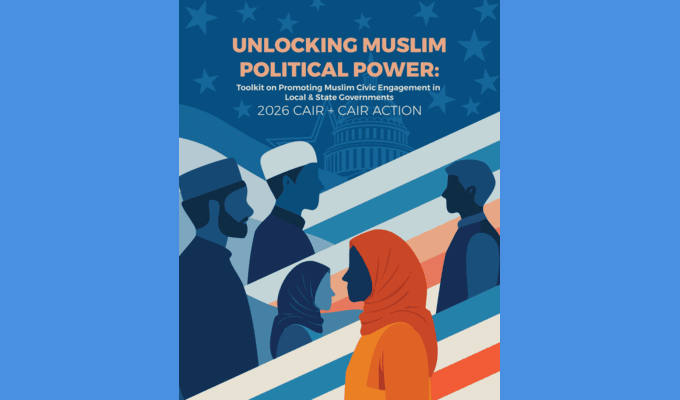
The Council on American-Islamic Relations (CAIR) today announced the release of its 2026 Toolkit on Promoting Muslim Civic Engagement in Local and State Governments, a comprehensive advocacy resource designed to help American Muslims and their allies advance inclusive, rights-affirming policies at every level of government.
ADVISORY: Join us for a webinar on Tuesday, January 13, at 7:30 PM ET, during which we will walk through the 2026 Toolkit on Promoting Muslim Civic Engagement in Local and State Governments.
REGISTER: Webinar: 2026 Toolkit to Empower Muslim Civic Engagement in Local and State Governments
As Muslim communities across the United States increasingly step into the civic arena, the new toolkit equips CAIR chapters, CAIR Action offices, Islamic organizations, students, and community advocates with practical tools to transform grassroots concerns into concrete policy victories. The resource compiles model resolutions, proclamations, executive orders, acts, and bills introduced or enacted in jurisdictions nationwide, offering adaptable language, strategic guidance, and real-world examples.
READ THE FULL TOOLKIT HERE
The toolkit addresses a wide range of policy areas central to Muslim communities, including:
Cultural Recognition
Muslim Heritage Month resolutions
Ramadan and Eid resolutions
Religious Accommodations
Halal food access in schools and correctional facilities
Protection of religious freedom in prisons
Sports religious headwear protections
Civil Rights & Equality
Measures condemning Islamophobia
Legislation addressing hairstyle and headwear discrimination
Free Speech & Political Rights
Efforts to overturn anti-BDS laws
Opposition to “No Sharia” legislation and similar discriminatory measures
Challenges to policies that suppress constitutionally protected advocacy, including the misuse of the IHRA definition to silence pro-Palestinian speech
Peace & Justice
Ceasefire resolutions
Statements affirming the right to advocate for Palestinian human rights, including protections for campus speech and civic engagement
“This toolkit is about power, participation, and principle,” said Shafiquil Muhshna, CAIR Government Affairs Department Coordinator. “American Muslims are not asking for special treatment—we are demanding equal protection under the law, respect for our identities, and the freedom to speak out against injustice. This resource provides communities with a roadmap to engage decision-makers, defend civil liberties, and advance policies rooted in justice and inclusion.”
CAIR emphasized that the toolkit is intentionally practical and action-oriented, offering step-by-step guidance to help advocates engage city councils, school boards, state legislatures, and governors’ offices. Whether pursuing a local proclamation or advancing statewide legislation, users can adapt the sample measures to meet the specific needs of their communities.
The 2026 Toolkit on Promoting Muslim Civic Engagement in Local and State Governments is available to CAIR chapters and partners nationwide and is intended to support sustained, proactive civic engagement that strengthens democracy and protects civil liberties for all.