

Chicago Tribune: Local victims and heroes of 9/11 remembered 25 years later: ‘The best part of me was gone … forever’
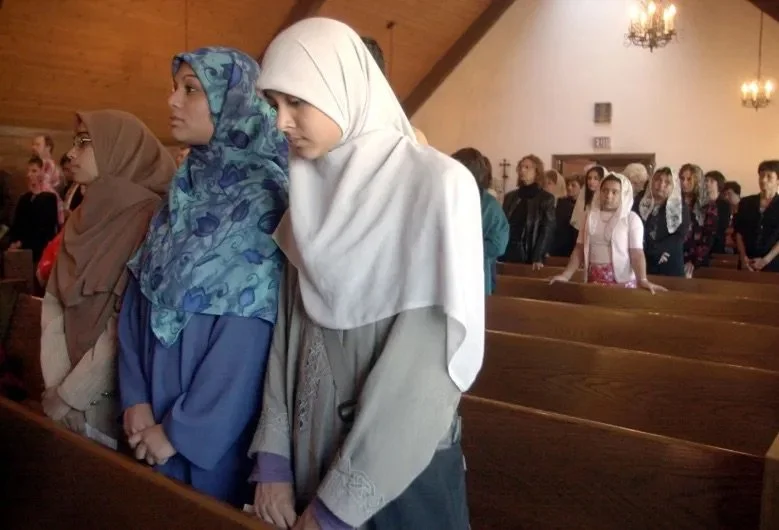
Members of many different faiths attend a Sunday service at St. John’s Assyrian Church of the East on Sept. 30, 2001. The interior of the church was damaged by fire during an attack the week prior. (Jim Prisching/Chicago Tribune)
A movement grew nationwide and locally to encourage more reporting and documentation of incidents, recalled Sufyan Sohel, senior adviser and general counsel for the Chicago office of the Council on American-Islamic Relations.
And there were bright moments when allies showed staunch support, like a bouquet of yellow flowers left outside a Des Plaines mosque following the attacks, with an anonymous note reading “May all your families be safe.”
The number of reported hate crimes against Muslims never dropped to pre-Sept. 11, 2001, levels, though they did decrease markedly throughout the later 2000s and early 2010s, according to a 2023 Marshall Project Report citing FBI data.
But in recent years, Islamophobia and anti-Arab rhetoric have once again increased; Sohel cited the 2016 presidential election as a major turning point spurring this spike.
During the heated campaign, Donald Trump declared during a CNN interview, “I think Islam hates us.”
Last month, President Trump referred to Democratic candidates running in the midterm elections as “jihadists.”
Some elected leaders tried to tamp down the national temperature in 2001.
And after 9/11, there was also a strong feeling of cohesion among many Americans, with much of the nation banding to take care of one another and heal collectively, Sohel recalled. Much of the bigotry was still on the fringe.
Today, the country is so much more fractured; hate has become normalized, he added.
“When we hear elected officials speak so negatively and filled with hate against our community, it tells our community: Hey, they will never see us as Americans,” he said.